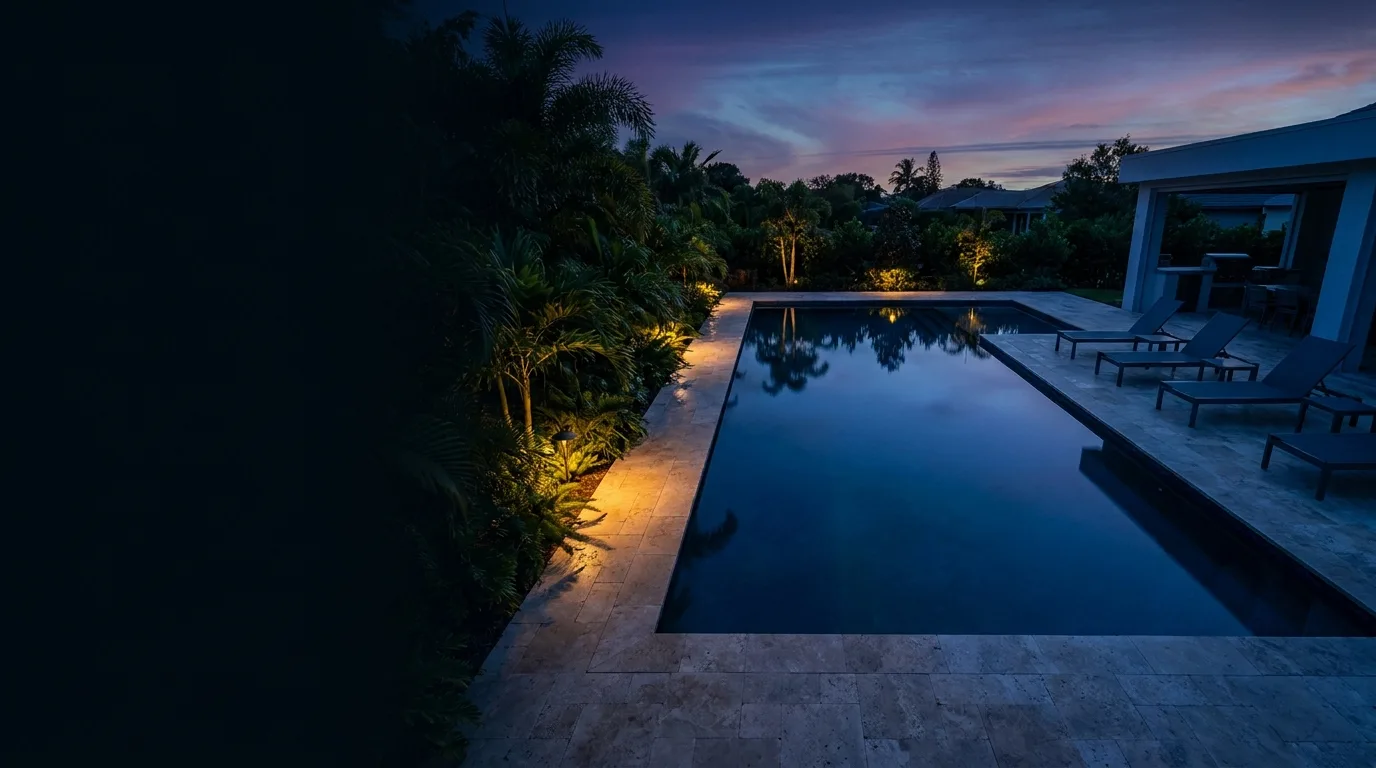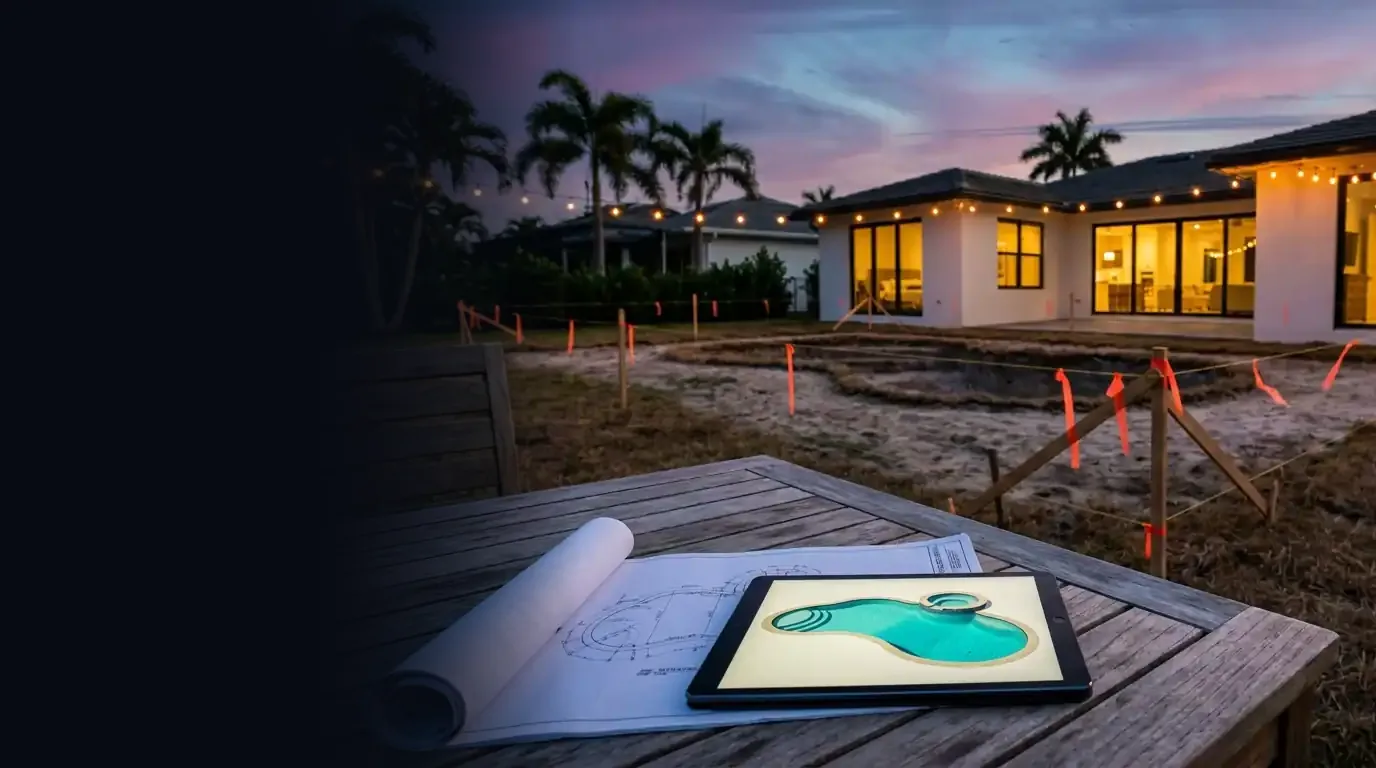
Nobody needs a pool. A family decides they want one, then spends the better part of a year working out which builder they can trust with their money and their yard. Every good piece of pool builder marketing follows from that, and it's the part the usual tactics lists never mention.
One conclusion is awkward for an agency to admit: ads are the least trusted thing a pool buyer sees on the way to signing. We run ads for a living. We'll explain why that's fine.
Why a Pool Isn't Sold Like a Roof or an AC Unit
A dead AC unit in July is a need. The homeowner wants it fixed today, the window to decide is short, and the marketing job is mostly being found first and sounding competent. A pool is the opposite kind of purchase: elective, considered, design-led, bought once and lived with for decades. Buyers spend $70,000 or more, hand over their backyard for about four months, and pick the builder that feels safest rather than the one that's cheapest. Everything below is a consequence of that.
Pool Buyers Can't See Quality, So They Compare Price
A buyer holding a $60,000 quote and a $130,000 quote is almost never looking at the same pool. The pricier one usually includes better decking, tile, finish, automation, lighting or a screen enclosure, or it prices in a harder lot. The buyer can't see any of that. They see two numbers, and the smaller one is easier to say yes to.
Then there's the lowball-then-upgrade play. A competitor quotes basic materials to land the lowest number, then adds $20,000 to $40,000 in upgrades at the showroom. You lose the quote, and because the buyer signed for less than you asked, it looks like you were too expensive. Builders lose jobs this way and then blame their marketing.
Marketing's job is to explain the difference before the quote lands: what custom means, what's inside a number, why the cheaper one may grow. None of that fits in a flat price. What a pool costs depends on the lot: the slope, the setbacks, the access, whether it needs a retaining wall. So any flat number is either wrong or an invitation to the lowball comparison above. The lot sets the number.
Pool Buyers Audit the Builder Before They Call
Before a family ever fills out a form, they've checked your contractor license, your insurance, how long the company has been around, your reviews, how you reply to the bad ones, and how big a deposit you ask for. You're being audited and you don't know it. That's why reviews, project photos and the website belong in a conversation about ads. The ad only earns the click. The audit decides whether the click becomes a call.
Deposit size is on that list for a reason. In Florida, buyers have watched pool companies take deposits and never finish, and the company was usually the cheapest bid. Wherever you build, being undercut is a trust problem, not a price problem.
Three Pool Buyers Who Need Three Different Messages
- The growing family: kids around 6 to 14, watching the budget, usually financing. The message is about how the family will use the yard and what the monthly number looks like.
- The equity couple: in their 50s or 60s, paying cash or with a small loan, moving fast and closing at a high rate. They want custom and quality, so the message is design and craftsmanship, not a payment.
- The new-build owner: an empty yard in a newer development, used to permits and builders, optimizing for speed, cost and quality all at once. The message is a clear process.
One ad can't talk to all three. Trying to is how you end up with vague dream-pool copy that attracts everyone and qualifies no one.
Financing Turns the Quote Into a Monthly Payment
Finance buyers compare the monthly payment, not the quote, and $100,000 at 8.5 percent over 30 years works out to about $769 a month. Deals can die at financing even after the design is done. A lender apply link on your site is a marketing asset, because it answers the question before the buyer has to ask it.
Pool Buyers Sign in Fall to Swim by Summer
Permitting takes months, so buyers who want to swim by summer sign in fall. The reason is lead time, not a discount. Awareness content works best from August to October, and by April most searchers are already behind.
Emergency trades work the other way: demand shows up the moment something breaks. A pool buyer's calendar starts the autumn before.
Meta Ads Reach Pool Buyers Months Before They Search
Pool builder advertising on Meta runs on a different clock than search. Nobody woke up this morning shopping for a pool. That's why Meta leads are cooler than search leads and need more follow-up. In our accounts, Meta leads book into appointments at about 45 percent and Google leads at about 56 percent. Pool Perfection's Meta leads booked at 47 percent. That gap is real, and it's the price of reaching buyers before your competitors do. We'd pay it.
We build Meta in three layers. Awareness is build-timelapse video that puts a finished project in front of people who weren't looking. Consideration is retargeting the people who watched, with design ideas and financing messages. The lead layer is the consultation booking, with a local offer and a fast follow-up. The standard offer across our client ads is a free 3D design and estimate, which fits how the sale already works, since design comes before price anyway.
The ads are only as good as what they point at. A good ad that sends people to 8 photos does less than an average ad that sends them to 80, so we treat the photo library as the ads' infrastructure. Real finished projects, not stock. And every ad names the city or service area, because pool building is local and permitted, and national-sounding copy does badly.
One pattern from our own testing, held loosely. Hooks that speak to the comparison moment, like 'Comparing quotes from three pool builders?', and hooks that explain what custom actually means tend to win. Generic 'why homeowners choose us' angles have not.
That's the short version of how we run Meta ads for pool builders.
The Google Ads Settings That Separate Pool Buyers From Pool Tables
The first problem in a pool builder's Google account is the word itself. 'Pool' also means pool tables, carpools and betting pools, so a pool builder's account needs a big negative keyword list from day one. The categories that matter:
- Wrong kind of pool: pool table, carpool, betting pool
- Jobs
- DIY
- Above ground and inflatable
- Service and chemicals, but only if you don't do service
- Price shoppers: 'cheap', 'no credit check'
- Real estate: 'homes with pool'
- Supply and trade
Then the easiest fix. People research pools from anywhere, including other states, long before they're ready, and Google's default location setting serves them too, so you end up paying for dreamers outside your service area. Google's own documentation on location options separates 'Presence' from 'Presence or interest.' Choose presence. Target people located in your area, not people interested in it. It's the best five seconds you'll spend in the account.
Split the campaigns by intent so each one is judged on its own terms: brand; core construction, like 'custom pool builder [city]'; cost research searches, which are real buyers on a longer cycle; remodel; and outdoor living, because someone shopping for an outdoor kitchen isn't a pool prospect.
The piece most agencies skip is offline conversion import. With a sale that takes months and a design that takes hours, a form fill is a weak signal of a buyer. So appointments and signed deals flow from your CRM back to Google, and Smart Bidding optimizes for real appointments instead of form fills. Google documents how importing offline conversions works.
Now the number the account should be judged against. Say the average job is $70,000 and you close 30 percent of appointments. That's an example, so swap in yours. Each appointment is worth $21,000. Not the cost of a click, the value of an appointment.
At $21,000 an appointment, a paid click at 7pm that rings an empty office is the most expensive thing in the account, and nobody sees it happen. If no one answers after 6pm, pull the ad schedule back to 6pm or add an answering service.
Then set the budget to capacity. Each design takes a designer hours, so if your team can run four appointments a week, that's the ceiling, however much the platform would happily spend. Work backward from your design calendar and the number follows.
The biggest leaks are settings, not strategy. That's how we run Google Ads for pool builders.
Pool Leads Get Qualified Before the Sales Call, Not On It
Every design takes 3 to 4 hours, so an unqualified appointment burns half a designer's day. By the time a lead reaches a designer, five questions should already have an answer, on the form and again on the first call:
- Do you own the home?
- Do you have a property survey?
- Where are you located?
- What's your budget?
- Will both partners be there?
Each question earns its place. Ownership and location screen out the renters and the out-of-area. The survey matters because most buyers don't know where theirs is, and a new one takes 5 to 10 days. Asking early starts that clock before the appointment, not after. Skip it and booked-looking buyers go quiet. The budget lets the designer stay inside a number. And both partners in the room means the decision can actually happen there.
Right after the form is submitted, a short video plays. It says who will call and what they'll ask, shows a face, frames the appointment as a design conversation, and flags the survey. Few competing builders have one, which makes it one of the cheapest ways to look different during the audit.
When leads look bad, we check speed to lead first. A lead called back the next morning isn't a bad lead. It's a slow callback. A bad lead is one of exactly six things:
- A renter
- Outside the service area
- No address yet
- Wants a repair or resurface only
- Budget too low
- An HOA that won't approve a pool
Anything else is usually follow-up or pricing. Rising interest rates fool people here: lead volume holds while fewer buyers sign, and it looks like quality slipped when the change is upstream. For the longer version of how this goes wrong, see why most contractor leads go bad.
Content Builds the Pool Buyer's Shortlist, and Ads Convert It
Everything so far happens in the last few steps of a long walk. Here's the whole walk, and where each channel earns its place.
A Pool Buyer's Nine Months From First Thought to Signed Contract
From first thought to signed contract, a pool buyer spends about nine months, and the marketing that matters changes at each step.
- Thinking about it: a trigger like a baby, a bonus, a hot summer or a neighbor's new pool, so social posts of finished projects matter, often months before any search.
- Researching: 6 to 12 weeks of questions about process, cost and timeline, so blog content matters, and AI tools read it too.
- Looking for companies: gathering 3 to 5 names, so Google Business Profile posts and photos, social and backlinks matter, because buyers cross-check.
- Checking them out: cutting the list to about 3, so photos, profiles and review replies matter.
- Getting in touch: an ad click, a form or a call, so the landing page, the qualifying form and the post-form video matter.
The last three steps, the callback, the qualifying call and the booked appointment, are the qualification work covered above.
The decision starts weeks earlier, on a phone at night, on a website nobody was tracking. By the time a builder gets the lead, the shortlist of two or three is usually already made.
Ads convert the shortlist. Everything else builds it.
Paid Ads Rank Last of the Six Sources Pool Buyers Trust
The order goes like this. A neighbor's referral comes first, then seeing a finished pool in person, then Google reviews and photos, then an AI recommendation, then organic search results. Paid ads come sixth. That's our observation from running these accounts, not a survey figure.
Ads get attention, but they can't create trust, so the reviews, the photos and the recommendations have to already be in place when the click arrives.
An agency that only runs ads is selling the least trusted piece of the process.
Google Business Profile Photos Do the Work Reviews Stop Doing
Buyers scroll the photo tab before they read a single review. Past 4.5 stars, reviews stop deciding and photo volume takes over. Someone weighing a $120,000 project wants to see a lot of finished backyards, and the upkeep is an ongoing job, not a one-time upload. The material comes from the same place as the ads: one shoot stocks the ads, the profile, the website and the design consultation. Managing that profile is the core of our Google Business Profile management.
Search and AI Answers Read the Builder's Own Website
AI tools and search answer from what's written on a builder's own website. A builder who hasn't written out their process, their approach to pricing and their timeline usually doesn't show up at all.
So every blog we write has to pass one test: could it have been written without interviewing the builder? If yes, it gets rewritten, because process content has to describe that builder's own process, never a generic one. Location pages work the same way. Thin, templated city pages risk a penalty across the whole domain. That work is what SEO and GEO for pool builders covers.
A Pool Inquiry in March That Signs in September Is Normal
Buyers wait on money, on a house closing, on a partner. Email retargeting, social posts and new project posts keep a builder visible while they do. Every website we build has tracking in from day one, so the late signings still get credited to whatever started them. That's the idea behind reporting that follows a lead to a signed contract.
What to Look for in a Pool Marketing Agency
Everything above turns into a short set of criteria. Whether you're the owner or the person who was handed the search, these separate a pool marketing agency that understands the sale from one that picked pools as a vertical.
An Agency That Serves Only Pool Builders and Admits Its Limit
Look for an agency that works only with pool builders and outdoor living contractors, and ask who it isn't for. Ours isn't for a builder competing on lowest price. Everything in this post is a trust-based approach, and trust doesn't win a race to the cheapest quote.
Geographic Exclusivity With Numbers Behind It
One builder per market. The non-compete means leads are never shared with a competitor, but on its own that claim is table stakes, so here's the proof. From June 1, 2025 to June 1, 2026, all-inclusive, Pool Perfection booked 950 appointments at $312.02 each, at a 2.16 percent cost of marketing. Over three years its revenue grew from $10M to $15M+. The full numbers are in the Pool Perfection case study.
At Oasis Outdoor Living, monthly revenue doubled within 3 months, cost per appointment fell 26 percent and $500K in revenue was added, which sits on our results page.
Reporting on Appointments and Revenue, Not Clicks and Impressions
Ask what the monthly report leads with. If it's clicks and impressions, you're reading the agency's activity, not your business. Then ask whether appointments and signed deals flow back into Google and Meta, so the algorithms optimize for your calendar, not for form fills. Appointments, signed contracts and revenue are the numbers that pay you. Measure, optimize, or fire us.
Contract length, who owns the ad accounts and data, and how the non-compete works all have straight answers on our FAQ page. Read those before any call, ours or anyone else's.
The pool sale is different, so the marketing has to be. Pool company marketing that starts from a tactics list has skipped the buyer: someone who takes about nine months, audits you before they call, and buys from the builder who feels safest.
Fewer leads. More jobs.
Pool Company Marketing Questions
Yes. Concrete, either gunite or shotcrete, is sprayed over a steel frame and can take any shape, depth or feature, which is what most high-end custom builders work in. Its message is design freedom and what custom really means. Fiberglass is a prefab shell, fast, but shapes are limited to what fits on a truck, and it costs more than people expect once decking is added. So a fiberglass message is speed, with honest numbers on the finished cost.
Build awareness before the season, so the buyers who sign in fall already know your name. Then cap spend at the number of appointments your designers and project managers can handle, however much the platforms would take. Spend past that capacity fills a calendar you can't serve. Working backward from your design calendar shows the math.
No flat price. The lot sets the number, and a flat figure either misleads the buyer or hands a lowball competitor the comparison. Use the website to explain what goes into a number instead: the decking, the finish, the automation, the lighting and the lot itself. Then let the design conversation set the price. A buyer who knows what's inside a quote is harder to undercut.