
We're talking ad spend here, not agency fees. Every shop charges differently for management, and mixing the two together is how these conversations turn into mush. Ad spend first. Management goes on top at the end, and we'll get to that.
What Are You Actually Trying to Do?
Before any number means anything, answer these honestly.
What's your capacity? Not your ambition. How many consultations can your design team run in a week before the quality of those conversations starts slipping.
What's the goal? More appointments, or better ones? Filling a calendar and filling it with the right people are different jobs with different budgets.
And why are you marketing at all right now? Growing into a new market is a different spend than holding the ground you have.
Most builders skip straight to "what should I spend" without answering any of that. Which is how you end up with a budget that has no relationship to your business.
What Does a Pool Lead Actually Cost?
In competitive markets, across Meta and Google, we see cost per lead land between $100 and $200. Google tends to run higher lately.
Competitive means what it sounds like. A metro with a lot of builders, all bidding for the same homeowners, all chasing the same attention. Every homeowner who wants a pool has a dozen companies within reach of them, and you're paying for the privilege of being one of the ones they notice.
If you're in a thinner market, your number will be better than that. If you're in Tampa or Phoenix or Dallas, plan for the top of the range.
For the rest of this, let's use $150 a lead. Swap in your own number when you run it.
How Many Leads Does It Take to Book One Appointment?
In our accounts, roughly one appointment for every two paid leads.
That ratio isn't free, though. It holds when several things are true at once:
- The tracking is actually in place, so you know which leads came from where.
- The qualification questions are doing real work, not just collecting a name and a phone number.
- The service areas are defined tightly, so you're not paying for homeowners you'd never drive to.
- And somebody calls fast. A real person, quickly, not an AI receptionist and not a callback tomorrow afternoon.
That last one carries more weight than most builders think. The MIT Lead Response Management study, which analyzed more than 15,000 leads and 100,000 call attempts, found the odds of qualifying a lead drop by 21 times when you call at 30 minutes instead of 5. Same lead. Same ad. Twenty-one times worse odds because somebody was at lunch.
One honest caveat on the 50% figure: it's measured on a roughly two-week look-back, and it understates reality. Plenty of leads don't book until a month later, sometimes longer. They aren't counted as booked yet, but they will be. Stretch the reporting window and that ratio climbs.
Our own published numbers back the benchmark up. The Pool Perfection campaigns converted Meta leads into appointments at 47%, against an industry standard we would put closer to 25 or 30%.
Half of what you pay for should end up on a calendar. If it doesn't, the problem usually isn't the ads.
Let's Run the Actual Math
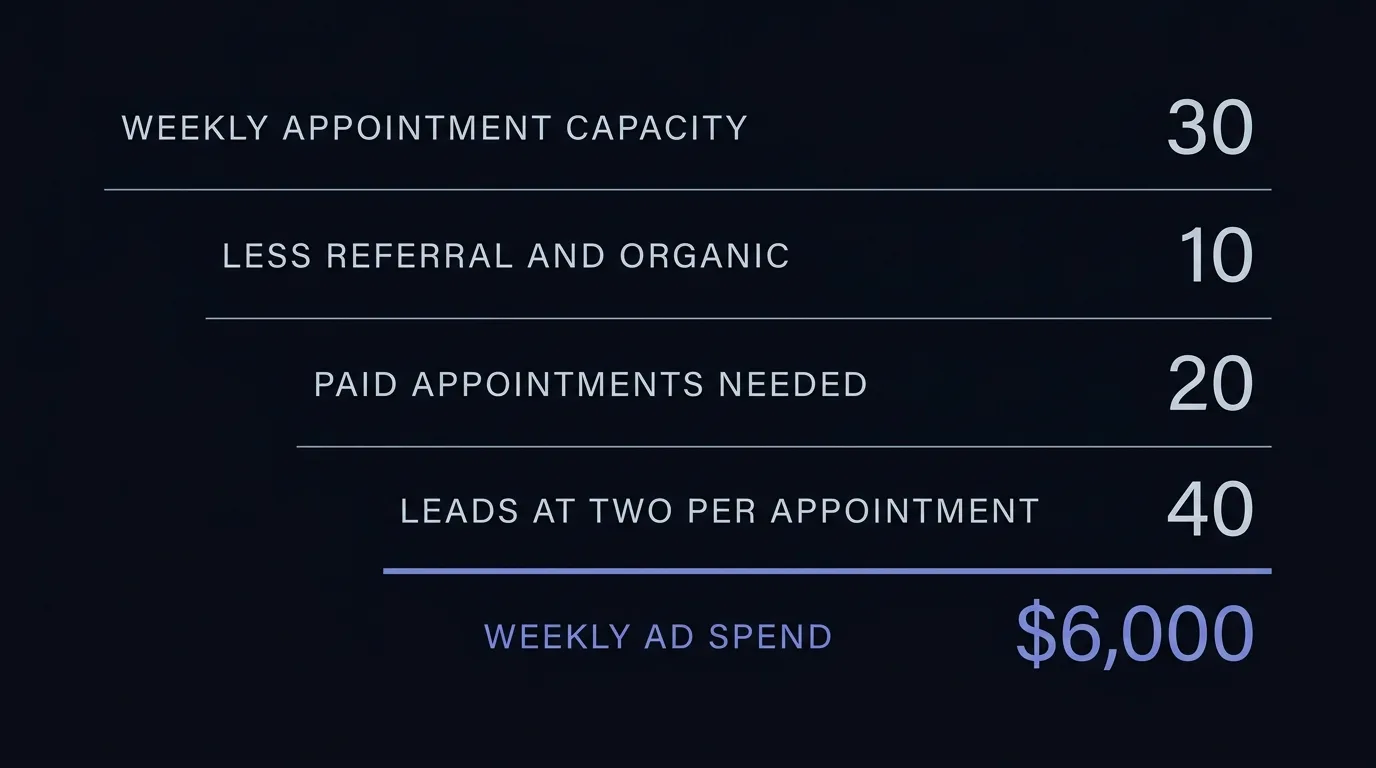
Say your design team can handle 30 appointments a week. That's your ceiling.
Now, how much of that fills itself? For a lot of established builders, referrals and organic traffic cover around 30%. Call it 10 appointments a week you're not paying per-click for.
That leaves 20 appointments a week that paid media has to deliver. At one appointment per two leads, 20 appointments needs 40 leads. At $150 a lead, 40 leads costs $6,000.
So your ad budget is $6,000 a week. And your cost per appointment, ad spend only, is $300.
Which, if you've read our other posts, should look familiar. The Pool Perfection case study came in at $312.02 per appointment all-in, management included, across 950 appointments in a year. Two completely different roads to nearly the same number, which is usually a sign the math is sound.
"Six Thousand a Week? No Chance."
That's the reaction, and it's the wrong instinct. $6,000 a week is only expensive or cheap relative to what comes out the other end. So finish the calculation.
Thirty appointments a week at a 20% close rate is six signed contracts. At a $100,000 average project, that's $600,000 in weekly contract value off a full calendar.
Now be strict about attribution, because a third of those appointments came from referrals and organic that your ad spend didn't buy. The paid slice is 20 appointments, four closes, $400,000. That's the honest number to hold against the $6,000.
$6,000 producing $400,000 is a 1.5% cost of marketing on ad spend. Even if your average project is half that size, say $50,000, you're at $200,000 against $6,000, which is 3%. Both sit comfortably inside the healthy range we laid out in the COM% post.
Obviously the revenue doesn't arrive that week. Pool sales close on their own schedule, sometimes six months out, sometimes longer. But if those appointments are real and your close rate holds, you're not overspending. You're printing.
And if the math doesn't work when you run it with your own numbers, that's the most useful thing this post can tell you. It means your cost per lead is too high, your appointment rate is too low, or your close rate needs work. Every one of those is fixable, and none of them get fixed by spending less.
What This Leaves Out
Management. All of it.
Whether you've got an agency or somebody in-house, that cost sits on top of the ad spend, and it belongs in the number. Add it in and you get your true cost per lead, your true cost per appointment, and eventually your true cost per signed contract. That's the version worth reporting, and it's what we mean by reporting across the whole funnel.
The ad spend number tells you what to budget. The all-in number tells you whether it's working.
Frequently Asked Questions
Work backward from capacity rather than from a percentage. Take your weekly appointment capacity, subtract what referrals and organic already produce, then multiply the remaining appointments by your cost per appointment. A builder needing 20 paid appointments a week, at two leads per appointment and $150 a lead, lands around $6,000 a week in ad spend.
In competitive markets we see $100 to $200 per lead across Meta and Google, with Google trending toward the higher end recently. Less saturated markets run cheaper. Cost per lead alone is a weak measure, so pair it with cost per appointment.
In our accounts, roughly two paid leads per booked appointment, provided tracking, qualification, service-area targeting, and fast human follow-up are all in place. Measured over a longer window the ratio improves, because some leads book a month or more after they come in.
No. Every figure here is ad spend only. Add management on top to get your true cost per lead and cost per appointment, which is the number that belongs in your cost of marketing percentage.
Then the budget isn't the problem. A high cost per lead usually points at targeting or creative, a low appointment rate points at qualification, follow-up speed, or where the ad sends people, which is why we're so particular about landing pages. Fix the leak before you turn up the volume.