
Without that, you don't have a marketing strategy. You have a marketing expense. You can't say which platform deserves more budget, which message is landing, or whether the money you spent in March did anything at all in June. You're flying blind and paying for the privilege.
Paid or Organic: What Are You Actually Paying For?
Before any of the reporting makes sense, you need to know which bucket a lead came out of. There are two.
Organic is when somebody finds you without clicking an ad. They Google your company, or a homeowner asks ChatGPT which builders are worth calling in their area and your name comes back. They land on your site, look around, and call or fill out a form. You didn't pay for that specific lead. You paid for the SEO, the content, and the reviews that made it possible, but there's no dollar figure hanging on that one person. No cost per lead.
Paid media is everything where you can draw a straight line from spend to leads. Meta ads, which covers Facebook and Instagram. Google Ads. Bing. Local Service Ads. Anything where you can look at a week and say we spent this much and got this many leads, then divide. That division is your cost per lead.
Both matter. They just get measured differently, and mixing them into one number is how builders end up thinking their marketing is cheaper or more expensive than it really is.
What Should a Marketing Report Actually Cover?
The whole funnel. Top to bottom, by channel, on a regular schedule instead of whenever somebody remembers to ask.
If your agency or your in-house marketer reports one number every month and that number is cost per lead, you're not being told anything useful. A lead generation report that stops at lead count is a headcount, not a report. Say your Meta cost per lead is $120 and your Google cost per lead is $160. Now what? Which one's better? You genuinely don't know yet. All you know is which one's cheaper, and cheap leads and good leads aren't the same animal.
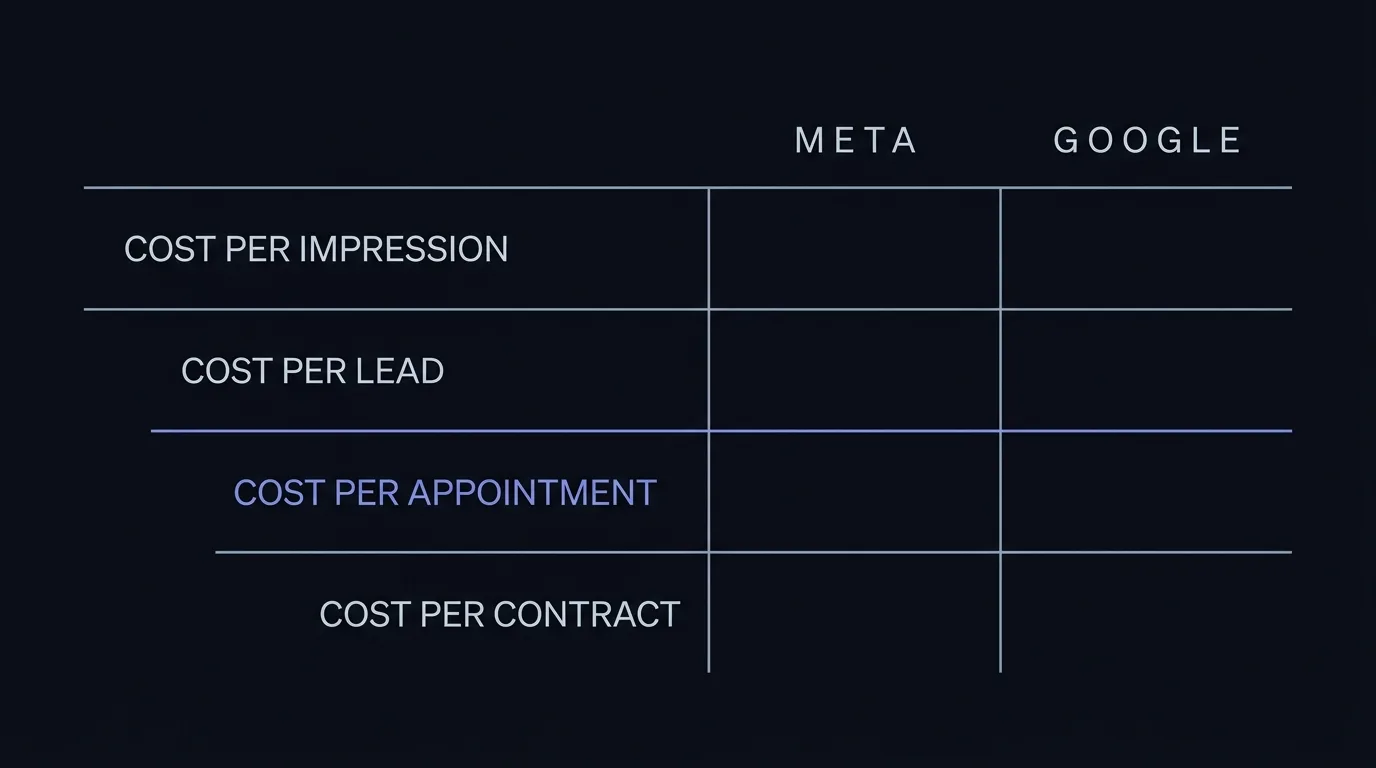
Think of it as a ladder. Every rung down tells you more than the one above it.
The Four Rungs, Top to Bottom
Cost per impression sits at the top, and the platforms usually report it as CPM, the cost per thousand impressions. It is the cheapest thing to measure and the least useful. It tells you people saw something.
Cost per lead is the next rung. Better. It means somebody raised a hand. It still says nothing about whether that hand belonged to a homeowner with a budget or a neighbor who wanted to see what a pool costs these days.
Cost per appointment is where reporting starts earning its keep. An appointment means a real person sat down with your designer, which means the lead finally cost you something scarcer than money: a slot on your design calendar.
Cost per signed contract is the bottom rung, and the one that ties everything back to your COM%.
Cheap leads and good leads aren't the same animal.
How Do You Calculate Cost Per Appointment?
Take one channel at a time. Meta, for example.
Pull what you spent on Meta in the period. Then count how many appointments came from Meta specifically. Divide the first number by the second. That's your cost per appointment for that channel.
The math is easy. The tracking is where everybody falls apart, because that second number is the one most builders can't produce. Leads land in one inbox from four different places, somebody books them by hand, and by the time an appointment shows up on the designer's calendar nobody remembers whether it started as a Facebook ad, a Google search, or a neighbor's referral.
And you can't just take the platforms' word for it. Meta and Google each count conversions using their own attribution rules, and both will happily claim the same homeowner. Add up what the two dashboards tell you and you'll count some of your best leads twice. The only version of this number worth trusting is the one that comes out of your own CRM, where the lead source got captured once and carried through to the booked appointment.
That's where reporting stops being paperwork and starts being the difference between scaling a channel and quietly funding a dead one.
What Does It Look Like When You Finally See It?
Picture a builder running Google and Meta at the same time with no appointment tracking.
Both channels are producing leads. The reports look fine. Then somebody finally connects lead source to booked appointment, and it turns out almost every appointment on the calendar came from Google. Meta's been generating leads for months and hardly any of them are sitting down with a designer.
That's not a reason to kill Meta. It's a reason to go look at Meta. Maybe the call to action is pulling in people who are still three years out. Maybe the ad is sending traffic to a homepage instead of a page built to qualify, which is a problem we wrote a whole post about in why landing pages boost lead quality. Maybe the form asks nothing that separates a buyer from a browser.
You can't fix any of that if the only number on the report is cost per lead. You'd look at Meta's cheaper leads and hand it more budget, which is exactly the wrong move. Bad tracking doesn't just leave you uninformed. It points you the wrong direction, confidently. It's one of the five reasons leads go bad in the first place.
We publish our own numbers this way, in appointments rather than leads. Over twelve months with Pool Perfection, an all-in cost per appointment of $312.02 across 950 appointments, at a 2.16% cost of marketing. The number underneath that result is the Meta lead-to-appointment rate: 47%, against an industry standard we would put closer to 25 or 30%. Roughly the same leads on the way in. A completely different outcome at the design table. You never see that gap if you stop measuring at the lead.
And when the tracking isn't there, fixing it is often the whole job. Oasis Outdoor Living came to us spending on marketing with no clear tracking and no real way to know whether any of it was profitable. Once proper tracking and reporting were in place, their cost per appointment dropped 26% and monthly revenue doubled inside three months. Their craftsmanship didn't change. They could finally see which channels were carrying the business.
Where Does Marketing's Job End and Sales' Job Begin?
At the appointment. Mostly.
Once a homeowner is sitting across from your designer, the outcome is on the sales side. Design, presentation, price, follow-up, the relationship. In our experience that's where the close lives, and it doesn't much matter whether the person came from an ad or found you on their own. If they showed up and they were interested, marketing did its job.
There's always more to tune. But a marketing team that consistently puts qualified people at your design table has done the thing you hired it to do, and judging that team on close rate is judging it on somebody else's work.
Your Sales Team Is a Reporting Channel Too
Almost nobody builds this into their reporting, and it costs them.
Talk to your sales team on a regular schedule. Not once a quarter. Ask them which channels are sending people who are ready and which ones are sending tire kickers. They know. Lead quality is the thing sales cares about more than anything, and they're sitting on the most detailed data in your business, almost none of which ever gets written down.
Then take it back to the campaigns. That feedback is what tells a marketer to rewrite the messaging, rebuild a landing page, or add a qualifying question so the wrong people filter themselves out before they ever reach your calendar. The numbers tell you which channel is underperforming. Your sales team tells you why.
That's a lot of what our reporting work actually is, and it's why we stay in contact with our clients' sales teams instead of just mailing over a dashboard.
Frequently Asked Questions About Marketing Reporting
A paid lead comes from advertising you're actively spending on, like Meta ads, Google Ads, Bing, or Local Service Ads, and it has a measurable cost per lead. An organic lead finds you without clicking an ad, through search, an AI answer, or your Google Business Profile. Organic leads aren't free, since SEO and content produce them, but there's no direct cost attached to any single one.
Cost per appointment is your marketing spend on one channel divided by the number of booked appointments that came from that channel. If you spent $6,000 on Meta and Meta produced 12 booked appointments, your cost per appointment is $500. It matters more than cost per lead because it measures the people who actually reached your design table.
Spend, leads, booked appointments, and signed contracts, every one of them split by channel, plus notes from your sales team on lead quality. Whether it gets labeled a digital marketing report, a lead generation report, or just "the monthly," the shape should be the same: enough of the funnel that you can see which channel produced revenue, not just which one produced volume.
Cost per lead only measures the top of the funnel. A channel can produce the cheapest leads in your account and still generate almost no appointments and no signed contracts. Without appointment and close data broken out by channel, you can't tell the difference between a cheap channel and a profitable one.
Because Meta and Google each count conversions on their own attribution rules, and both will claim credit for the same homeowner. Adding the two dashboards together double counts leads. Treat your CRM as the source of truth and the platform numbers as directional.
Review paid channel performance weekly so you can catch a problem while it's still cheap to fix, and review full-funnel results monthly against your COM% and your close rate. Because outdoor living sales cycles run long, always read the monthly numbers alongside the accrued revenue still working its way through your pipeline.
Ask for cost per appointment by channel. If they can't produce it, the tracking isn't in place, and that's fixable. Lead source needs to be captured at the form or the call, carried into your CRM, and tied to the booked appointment.